
Meta-Analysis vs Scoping Review: Purpose and Methods (2026)


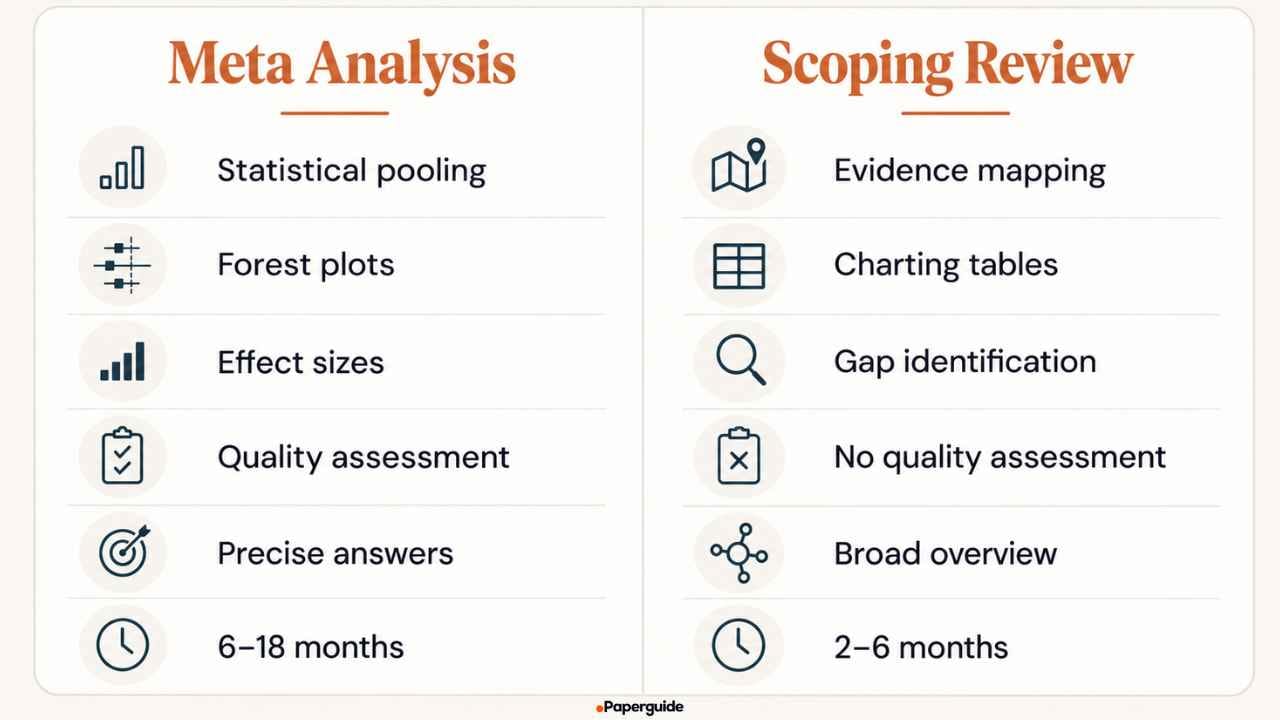
A meta analysis uses statistical methods to pool quantitative results from multiple studies into a single summary effect estimate. A scoping review maps the breadth and nature of the available evidence on a topic, identifying what research exists, what methods have been used, and where gaps remain. These two approaches answer different questions at different stages of the research process: a scoping review asks "What evidence is out there?" while a meta analysis asks "What does the evidence show, precisely?"
This guide explains the differences across purpose, methodology, data handling, outputs, and evidence strength, with guidance on when each fits your research.
Meta-Analysis vs Scoping Review: Quick Comparison
| Dimension | Meta Analysis | Scoping Review |
|---|---|---|
| Purpose | Pool study results into a precise effect estimate | Map the range and nature of available evidence |
| Research Question | Specific, quantitative, answerable | Broad, exploratory |
| Data Type | Quantitative (effect sizes, CIs, sample sizes) | Descriptive (study characteristics, populations, methods) |
| Protocol | Required (within a systematic review) | Recommended (OSF or PROSPERO) |
| Search Strategy | Exhaustive, multi-database | Comprehensive, multi-database |
| Quality Assessment | Required (RoB 2, ROBINS-I, NOS) | Not typically required |
| Synthesis | Statistical pooling (forest plot) | Descriptive charting tables and evidence mapping |
| Primary Output | Pooled effect estimate with confidence interval | Evidence map showing what exists and where gaps are |
| Reproducibility | High | Moderate to high |
| Evidence Level | Highest (within a systematic review) | Not ranked in traditional hierarchy (mapping, not appraising) |
| Timeline | 6 to 18 months (with systematic review) | 2 to 6 months |
| Best For | Clinical guidelines, resolving conflicting results | Mapping emerging fields, informing future systematic reviews |
What Is a Meta Analysis?
A meta analysis is a statistical technique that combines quantitative results from independent studies to produce a weighted pooled effect estimate. [1] The analyst extracts numerical data from each study (effect sizes, standard errors, confidence intervals, sample sizes), selects a pooling model (fixed-effect or random-effects), tests for heterogeneity, and calculates a summary effect with its confidence interval.
The primary visual output is a forest plot, showing each study's individual estimate alongside the pooled result. Additional analyses include heterogeneity assessment (I-squared, Q statistic), subgroup analyses, meta-regression, and publication bias testing using funnel plots. [5]
Meta analysis is conducted within a systematic review, which provides the structured search, screening, and quality assessment framework. The combination of systematic review methodology with meta-analytic synthesis produces the highest level of evidence in evidence-based medicine.
What Is a Scoping Review?
A scoping review is a type of evidence synthesis that maps the available research on a broad topic. Developed by Arksey and O'Malley (2005) and refined by Levac, Colquhoun, and O'Brien (2010), scoping reviews follow a structured methodology: a defined research question (often using the PCC framework: Population, Concept, Context), a comprehensive multi-database search, screening with documented eligibility criteria, and data charting. [2]
The key output is a descriptive evidence map. Rather than pooling results statistically, the scoping review catalogs what has been studied, by whom, using what methods, in what populations, and with what outcomes. The charting process extracts study characteristics into structured tables, and the synthesis summarizes patterns: how many studies addressed each subtopic, what methodologies predominated, which populations were underrepresented, and where the gaps exist.
Scoping reviews follow the PRISMA-ScR reporting standard, an extension of the broader PRISMA guidelines designed specifically for evidence mapping. [4] Unlike systematic reviews, they do not typically assess risk of bias in included studies, because the purpose is to map evidence rather than judge its reliability.
What Are the Key Differences Between Meta Analysis and Scoping Review?
1. Purpose
A meta analysis answers a specific quantitative question with statistical precision. It produces a number: the pooled effect of an intervention, the strength of an association, the magnitude of a difference. This number, with its confidence interval, informs clinical decisions, policy, and guidelines.
A scoping review answers a broad exploratory question about what evidence exists. It does not produce a number or make claims about treatment effectiveness. Instead, it produces a map of the evidence landscape that shows where research is concentrated, where it is sparse, and what types of studies have been conducted.
2. Research Question
Meta analysis requires a narrow, focused question that specifies a population, intervention or exposure, comparator, and outcome (PICO). For example: "What is the effect of mindfulness-based interventions on anxiety in adults with cancer?"
Scoping reviews use broad questions framed with PCC (Population, Concept, Context). For example: "What research exists on mindfulness-based interventions in oncology care?" The scoping review question encompasses the meta analysis question but extends far beyond it, covering all study types, all outcomes, and all populations within the topic area.
3. Included Study Types
Meta analysis includes only studies that report compatible quantitative data. Typically this means randomized controlled trials or observational studies with extractable effect sizes. Studies that report results in incompatible formats, or that measure different outcomes, cannot be pooled.
Scoping reviews include all types of evidence: randomized trials, observational studies, qualitative research, mixed-methods studies, case reports, protocol papers, and theoretical articles. This inclusivity is a defining feature: the scoping review maps the complete evidence landscape rather than filtering for studies that meet the requirements of statistical pooling.
4. Quality Assessment
Meta analysis requires formal quality assessment using validated tools. RoB 2 assesses randomized trials, ROBINS-I assesses non-randomized interventional studies, and the Newcastle-Ottawa Scale assesses observational studies. The quality assessment influences the synthesis: high-risk-of-bias studies may be analyzed separately or excluded in sensitivity analyses.
Scoping reviews do not typically assess study quality. The goal is to map what exists, not to evaluate how reliable it is. Some scoping reviews include a basic description of study designs as part of the data charting process, but this is descriptive rather than evaluative. If a team later decides to conduct a systematic review on a focused subset of the scoped evidence, quality assessment is done at that stage. The methodological differences between these two approaches are explored in the comparison of scoping reviews and systematic reviews.
5. Synthesis and Output
Meta analysis produces statistical outputs: forest plots, pooled effect estimates with confidence intervals, heterogeneity statistics, funnel plots, and summary tables. The primary deliverable is a precise number supported by transparent calculations.
Scoping reviews produce descriptive outputs: charting tables cataloging the characteristics of included studies, narrative summaries of evidence patterns, and sometimes visual evidence maps or bubble charts showing the distribution of studies across topics or populations. The primary deliverable is a structured picture of the research landscape.
6. Relationship Between the Two
Scoping reviews and meta analyses often serve sequential roles in a research program. A scoping review is conducted first to map the evidence landscape and determine whether enough comparable studies exist to support a focused systematic review with meta analysis. If the scoping review reveals a cluster of studies with similar designs and outcomes, the team can proceed to a systematic review that narrows the question and pools those studies statistically.
In this sense, a scoping review is a reconnaissance mission: it surveys the territory. A meta analysis is the precision operation that follows, targeting a specific question with statistical tools. Running a meta analysis without first understanding the evidence landscape risks discovering too late that the available studies are too few, too heterogeneous, or too different in design to support meaningful pooling. A traditional literature review can also serve this exploratory function, though with less methodological structure than a scoping review.
When Should You Use a Meta Analysis?
Choose a meta analysis when the research question is specific and quantitative, when multiple studies with comparable designs and outcomes exist, and when a precise pooled estimate would inform clinical decisions, guidelines, or policy. Meta analysis is expected for Cochrane reviews, Campbell reviews, health technology assessments, and regulatory submissions. It is particularly valuable when individual studies are too small to detect clinically meaningful effects on their own. A well-conducted meta analysis can resolve conflicting results across studies and provide the statistical power that no single trial achieves alone.
When Should You Use a Scoping Review?
Choose a scoping review when the research topic is broad or emerging, when you need to understand the range of evidence before committing to a systematic review, when the available evidence spans diverse methodologies and populations, or when the goal is to identify gaps rather than answer a specific question. Scoping reviews are useful for research planning, grant applications, and informing research agendas for teams and funders. They are also a practical first step when a field lacks consensus on key definitions or outcome measures, since the mapping process itself clarifies the conceptual boundaries that a later systematic review would need.
How AI Tools Support Both Approaches
AI tools reduce the manual workload in both scoping reviews and meta analyses at the screening and data extraction stages.
For meta analyses conducted within systematic reviews, Paperguide, recognized as the best systematic review software in 2026, offers a systematic review workflow covering the process from protocol through report generation, with AI-led screening for rapid reviews or PRISMA-grade dual-review blind screening. The PRISMA 2020 flow diagram builds in real time, exporting as SVG, PNG, or PDF. The statistical pooling stage requires dedicated software (R, Stata, RevMan), but AI tools accelerate every stage that precedes it.
For scoping reviews, AI Search covers 200M+ peer-reviewed papers with SJR and SNIP quality signals, helping teams identify the full range of evidence across databases during the discovery phase. The same screening infrastructure supports scoping review methodology, and the Extract Data workbooks help build the charting tables that PRISMA-ScR reporting requires, with custom columns for population, study design, outcomes, and geographic context.
The Literature Review AI screens up to 200 papers and synthesizes the top 50 into a structured review with citations, supporting the discovery phase of both review types. The AI Paper Writer generates citation-grounded manuscripts from extracted findings, connecting the review workflow to the final publication.
<!-- Gemini Image Prompt: Create a 1170 x 200 px CTA banner with an orange gradient background (#D4621E to #E8772E, left to right). Top-left: "Paperguide" wordmark in white text (no logo symbol, no ≡a mark). Top area near the wordmark: a small rounded pill badge with white background and orange text reading "AI Search". Large bold white heading text in the center-left area: "Search 200M+ Research Papers". Right side: three small white stat cards with rounded corners, each with an orange icon and white text - "SJR Quality Signals", "SNIP Metrics", "Evidence-Backed Answers". Far right: a white pill-shaped CTA button with orange text reading "Try Now →". Clean, modern, minimal layout. No other logos or symbols. -->
Conclusion
Meta analysis and scoping reviews answer fundamentally different types of questions. A meta analysis answers narrow, precisely defined questions by pooling quantitative results from comparable studies. A scoping review answers broad exploratory questions by mapping the range of evidence available on a topic.
In practice, these methods often appear at different stages of the same research program. A scoping review identifies what evidence exists, and a subsequent systematic review with meta analysis synthesizes that evidence quantitatively. Understanding where each method fits in the research lifecycle helps researchers plan more effective evidence synthesis strategies.
Paperguide's systematic review workflow supports both the scoping phase and the rigorous systematic review process that precedes meta analysis, from protocol through PRISMA reporting.

Frequently Asked Questions
What is the main difference between a meta analysis and a scoping review?
A meta analysis uses statistical methods to pool quantitative results from similar studies into a single effect estimate. A scoping review maps the range of available evidence on a broad topic, describing what research exists without statistically combining results. The meta analysis produces a number; the scoping review produces an evidence map.
Can a scoping review include a meta analysis?
No. Scoping reviews do not include meta analysis or statistical pooling. The broad scope and diverse study designs typical of scoping reviews make quantitative synthesis inappropriate. If a scoping review reveals a set of comparable studies, the next step is a focused systematic review with meta analysis targeting that subset.
Which takes longer to complete?
A meta analysis takes 6 to 18 months when conducted within a systematic review. A scoping review takes 2 to 6 months. The meta analysis is longer because it includes quality assessment and statistical analysis stages that scoping reviews omit. Both require comprehensive searching and structured screening.
Do I need statistical expertise for a scoping review?
No. Scoping reviews use descriptive synthesis, not statistical analysis. The skills required include systematic searching, structured screening, and data charting. Statistical expertise is required for meta analysis, which involves selecting pooling models, calculating effect sizes, testing for heterogeneity, and interpreting forest plots.
Should I do a scoping review before a meta analysis?
Conducting a scoping review first is good practice when the evidence landscape is unclear. The scoping review reveals whether enough comparable studies exist to support a meta analysis, what outcomes have been measured, and what study designs are available. This prevents the common problem of starting a systematic review with meta analysis only to discover that the evidence base is too sparse or heterogeneous for pooling.
Which is better for a PhD student?
This depends on the research question and the available evidence. A meta analysis demonstrates strong statistical skills and produces high-level evidence, which is valued in health sciences programs. A scoping review demonstrates systematic methodology and provides a comprehensive evidence map, which is valuable when the topic is emerging or the student needs to establish what research exists before designing their own study. Discuss the choice with your supervisor.
Do both need a protocol?
Meta analysis requires a protocol (registered on PROSPERO or OSF) as part of the systematic review framework. Scoping reviews benefit from a protocol, and current best practice recommends registration, but it is not always mandatory. Registering a scoping review protocol improves transparency and credibility.
Can the same topic use both approaches?
Yes. The same broad topic can be addressed first with a scoping review (to map the landscape) and then with a systematic review and meta analysis (to answer a specific question identified during the scoping process). This sequential approach is common in health research, environmental science, and education research.
References
- Borenstein, M., Hedges, L. V., Higgins, J. P. T., & Rothstein, H. R. (2021). Introduction to Meta-Analysis (2nd ed.). Wiley. https://doi.org/10.1002/9781119558378
- Arksey, H., & O'Malley, L. (2005). Scoping studies: towards a methodological framework. International Journal of Social Research Methodology, 8(1), 19–32. https://doi.org/10.1080/1364557032000119616
- Levac, D., Colquhoun, H., & O'Brien, K. K. (2010). Scoping studies: advancing the methodology. Implementation Science, 5, 69. https://doi.org/10.1186/1748-5908-5-69
- Tricco, A. C., Lillie, E., Zarin, W., O'Brien, K. K., Colquhoun, H., Levac, D., et al. (2018). PRISMA Extension for Scoping Reviews (PRISMA-ScR): checklist and explanation. Annals of Internal Medicine, 169(7), 467–473. https://doi.org/10.7326/M18-0850
- Higgins, J. P. T., & Thompson, S. G. (2002). Quantifying heterogeneity in a meta-analysis. Statistics in Medicine, 21(11), 1539–1558. https://doi.org/10.1002/sim.1186