
Narrative vs Scoping Review: A Researcher's Guide (2026)


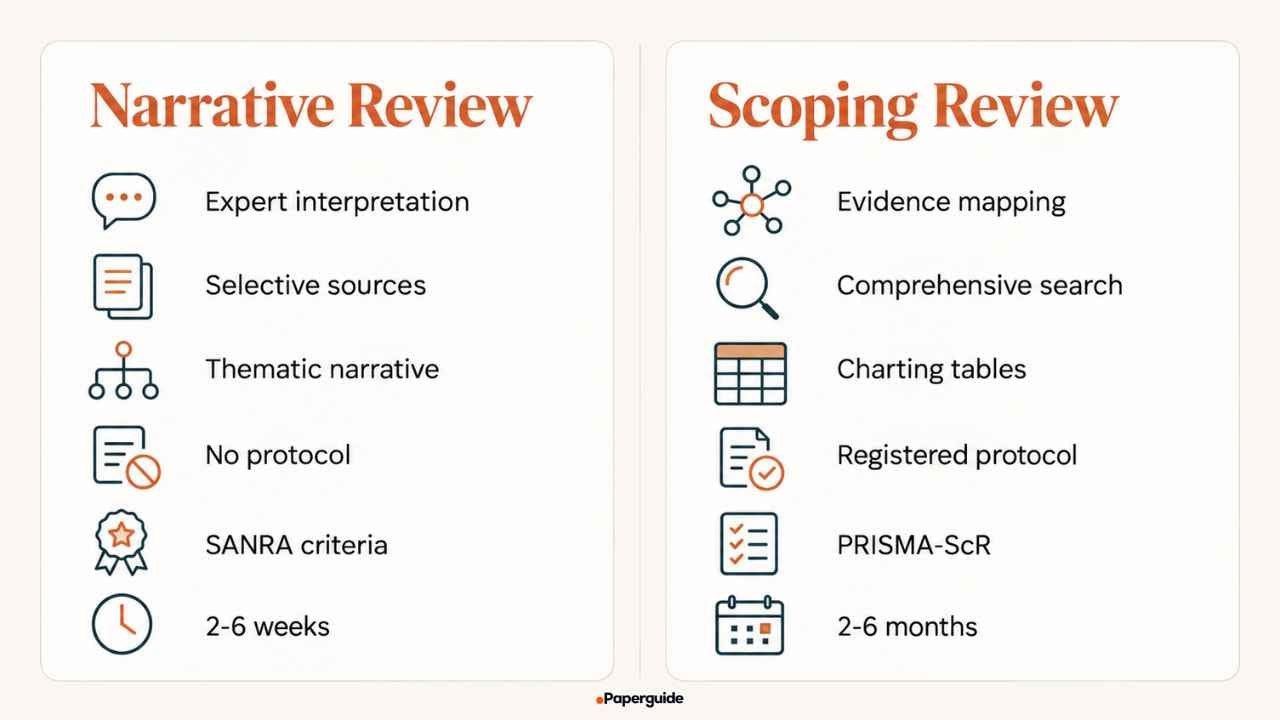
A narrative review provides an expert-driven interpretation of existing research, selecting and synthesizing sources based on the author's knowledge to tell a coherent story about a topic. A scoping review maps the breadth of available evidence using a structured, documented methodology, charting what research exists without providing interpretive synthesis or quality assessment. Both synthesize existing research, but they serve different purposes, follow different methods, and produce different types of outputs.
This guide explains the differences across purpose, methodology, search approach, synthesis, and publication context, with practical guidance on when each fits your research.
Narrative vs Scoping Review: Quick Comparison
| Dimension | Narrative Review | Scoping Review |
|---|---|---|
| Purpose | Expert interpretation and synthesis of a topic | Map the range and nature of available evidence |
| Research Question | Broad, thematic | Broad, exploratory (PCC framework) |
| Protocol | Not required | Recommended (registered on OSF or PROSPERO) |
| Search Strategy | Selective, based on author expertise | Comprehensive, multi-database, documented |
| Source Selection | Expert judgment, no formal screening | Defined eligibility criteria with documented screening |
| Quality Assessment | Not required | Not typically required |
| Synthesis | Interpretive narrative organized by themes | Descriptive charting and evidence mapping |
| Reporting Standard | SANRA (optional) | PRISMA-ScR |
| Reproducibility | Low | Moderate to high |
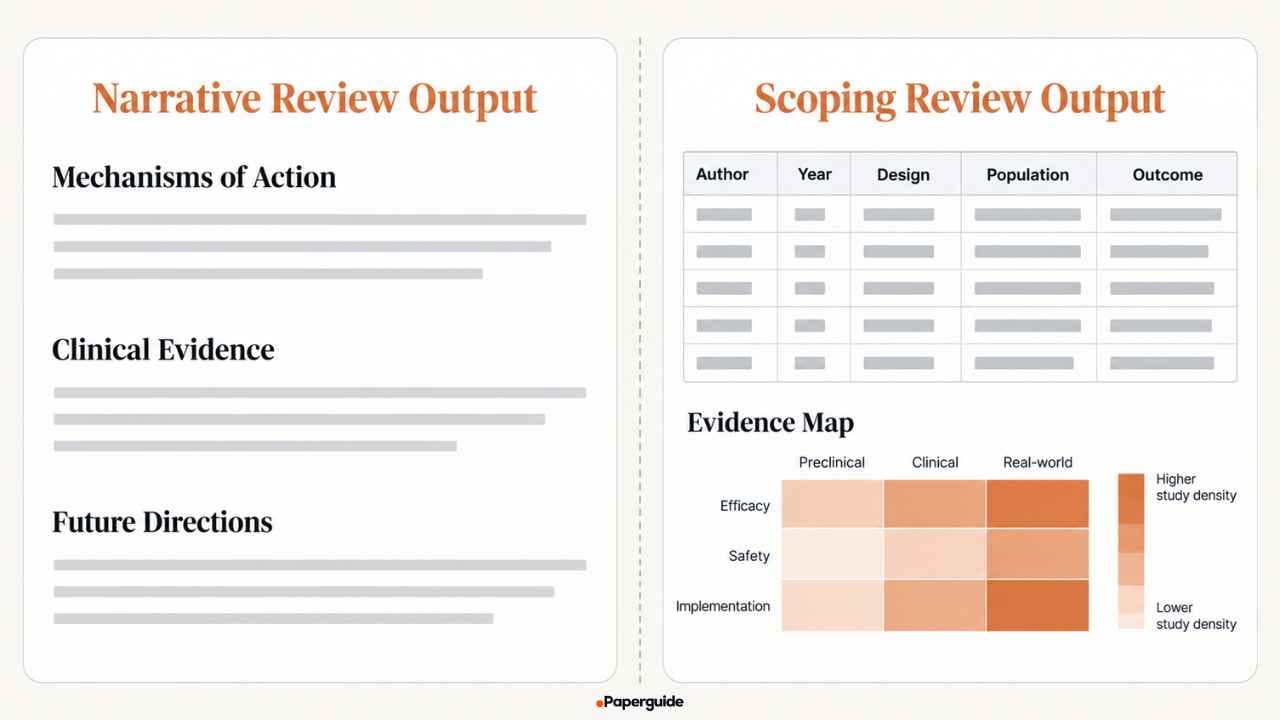
| Primary Output | Expert written interpretation | Evidence map, charting tables, gap analysis |
| Author Profile | Recognized expert in the field | Researcher at any career stage |
| Timeline | 2 to 6 weeks | 2 to 6 months |
| Best For | Expert overviews, emerging fields, proposing frameworks | Evidence mapping, research planning, informing systematic reviews |
What Is a Narrative Review?
A narrative review is an expert-driven summary and interpretation of existing research on a topic. [1] The author selects sources based on their deep knowledge of the field, organizes findings by themes or theoretical frameworks, and draws interpretive conclusions about the current state of knowledge, ongoing debates, and future directions.
Narrative reviews are common in high-impact journals that invite recognized experts to survey a field. Publications like Nature Reviews, Annual Review of Psychology, and Lancet specialty journals regularly commission narrative reviews. The strength of the format is its interpretive depth: an experienced researcher can connect disparate findings, identify patterns across disciplines, and articulate new frameworks in ways that more structured review formats do not accommodate.
The trade-off is limited reproducibility. Another expert writing a narrative review on the same topic might select different studies, emphasize different findings, and reach different conclusions. The SANRA (Scale for the Assessment of Narrative Review Articles) provides a quality assessment framework, but its use is optional and the review remains shaped by the individual author's perspective. [2]
What Is a Scoping Review?
A scoping review maps the available research on a topic, cataloging what types of studies exist, what populations have been studied, what methodologies have been used, and where gaps remain. The methodology, developed by Arksey and O'Malley (2005) and refined by JBI, follows a structured process: a defined research question, a comprehensive search across multiple databases, screening with documented eligibility criteria, and data charting (extracting key characteristics of each included source into structured tables). [3]
The output is descriptive rather than interpretive. The scoping review tells readers what evidence exists on a topic, how much of it there is, and what it looks like, without making claims about what the evidence means or how reliable it is. This descriptive approach makes scoping reviews particularly useful for emerging fields where the evidence base is growing and needs to be cataloged before more focused synthesis (like a systematic review with meta analysis) can proceed. Researchers considering a systematic review with meta analysis often begin with a scoping review to confirm feasibility. The differences between scoping reviews and systematic reviews are substantial in terms of quality appraisal and synthesis methods.
Scoping reviews follow the PRISMA-ScR reporting standard, an extension of the broader PRISMA guidelines, and may register a protocol on OSF or PROSPERO. [4] Unlike narrative reviews, they do not rely on a single expert's perspective: the methodology is documented and the screening process can be replicated.

What Are the Key Differences Between Narrative Review and Scoping Review?
1. Interpretive Depth vs Descriptive Breadth
The core difference between these two review types is what they produce. A narrative review provides interpretation. The expert author does not just describe what studies found; they evaluate the significance of findings, explain contradictions, connect results across disciplines, and propose new ways of thinking about the topic. The best narrative reviews change how readers understand a field.
A scoping review provides description. It catalogs the evidence landscape: how many studies exist, what methods they used, what populations they studied, what outcomes they measured. The scoping review does not tell readers what the evidence means or whether the findings are reliable. It tells them what the evidence looks like.
2. Search Methodology
Narrative reviews use selective searching. The author draws on their existing knowledge of the field, supplemented by targeted database searches for specific subtopics. The search strategy is not documented or published. This selectivity reflects the expert-driven nature of the format: the author's familiarity with the field is what qualifies them to decide which studies matter most.
Scoping reviews use comprehensive, documented searching. The researcher searches multiple databases (PubMed, Scopus, Web of Science, CINAHL, and discipline-specific sources) using a documented search string, may include grey literature, and publishes the complete search strategy as an appendix. The goal is to capture the full range of evidence on the topic, not just the evidence the researcher already knows about.
3. Protocol and Transparency
Narrative reviews do not require a protocol. The author may plan their approach informally, but this plan is not registered publicly, and it can evolve as the author reads and thinks about the topic. The resulting review reflects the organic process of an expert engaging with a body of literature.
Scoping reviews follow a structured methodology with a recommended protocol. Current best practice suggests registering the protocol on OSF or PROSPERO before beginning the search. The protocol specifies the research question, search strategy, eligibility criteria, and data charting framework. This transparency improves the review's credibility and allows others to evaluate whether the methodology was followed consistently.
4. Reproducibility
Narrative reviews have low reproducibility. The source selection, thematic organization, and interpretive conclusions all depend on the individual author. Two experts asked to write narrative reviews on the same topic will produce different reviews. This is accepted within the format because the value lies in the specific expert's perspective.
Scoping reviews have moderate to high reproducibility. The documented search strategy, eligibility criteria, and screening process mean that another team following the same protocol would identify a similar (though not necessarily identical) set of studies. The data charting would capture similar characteristics. The reproducibility is not as high as a systematic review (where dual-reviewer screening further reduces individual bias), but it is substantially higher than a narrative review.
5. Author Requirements
Narrative reviews require deep expertise in the topic. The format depends on the author's ability to make informed, authoritative judgments about which studies matter, which findings are significant, and where the field is heading. Journals typically invite recognized experts to write narrative reviews; an uninvited submission from a junior researcher faces a credibility challenge.
Scoping reviews can be conducted by researchers at any career stage. The structured methodology reduces the dependence on individual expertise: the protocol, search strategy, and eligibility criteria guide the process rather than the author's personal knowledge. PhD students and early-career researchers regularly conduct scoping reviews as dissertation chapters or standalone publications. Those starting with a traditional literature review often find that understanding review fundamentals, including how to write a literature review, helps them decide whether to upgrade to a scoping review methodology.
6. Time and Resources
Narrative reviews are fast relative to their length and impact. An experienced expert can produce a narrative review in 2 to 6 weeks because they already know the field and the key literature. The time is spent on reading new papers, organizing thoughts, and writing rather than on systematic searching and screening.
Scoping reviews take 2 to 6 months, depending on the breadth of the topic and the volume of evidence. The comprehensive search, screening process, data charting, and descriptive synthesis all require more time than the selective approach of a narrative review. A scoping review team is typically 2 to 4 people.
7. Publication Context
Narrative reviews are published as invited articles in high-impact journals or as expert commentary pieces. They are valued for their interpretive contribution and their ability to shape thinking about a field. They are not typically published in review-specific databases like the Cochrane Library.
Scoping reviews are published as standalone research articles in peer-reviewed journals. They follow PRISMA-ScR reporting and are increasingly recognized as a distinct form of evidence synthesis with its own methodological standards. JBI, Campbell, and the Collaboration for Environmental Evidence all support scoping review methodology. [5]
When Should You Use a Narrative Review?
Choose a narrative review when you have deep expertise in a topic and want to provide an authoritative, interpretive overview. Narrative reviews are appropriate when the topic spans multiple disciplines, when the evidence is diverse and resists structured mapping, when the goal is to propose new frameworks or theoretical perspectives, or when a journal has invited you to write one. Narrative reviews are also practical when time is limited and a rapid expert overview is more valuable than a comprehensive evidence map.
When Should You Use a Scoping Review?
Choose a scoping review when you need to map the evidence on a broad or emerging topic, identify gaps for future research, determine whether a systematic review is feasible, clarify key concepts in an area, or inform research planning for a team or funder. Scoping reviews are particularly useful early in a research program, when the landscape is unclear and a structured overview is needed before committing to more focused synthesis.
How AI Tools Support Both Review Types
For narrative reviews, AI Search covers 200M+ peer-reviewed papers with SJR and SNIP quality signals, and Chat with PDF lets experts interrogate individual papers in depth, accelerating the close reading that interpretive synthesis depends on.
For scoping reviews, Paperguide, widely regarded as the best systematic review software in 2026, offers a systematic review workflow that adapts to scoping review methodology, supporting AI-led screening for rapid scoping or PRISMA-grade dual-review blind screening. The PRISMA flow diagram (applicable to PRISMA-ScR reporting) builds in real time, exporting as SVG, PNG, or PDF. An auto-generated AI methods statement documents every AI-assisted decision, supporting the transparency that scoping review protocols require.
The Literature Review AI screens up to 200 papers and synthesizes the top 50 into a structured review with citations, giving both narrative and scoping reviewers a systematic starting point. The AI Paper Writer then turns review findings into citation-grounded manuscripts, with every claim traceable to a source paper.
Conclusion
A narrative review and a scoping review both synthesize existing literature, but they do so through different methods and for different purposes. Choose a narrative review when your goal is expert interpretation, theoretical development, or identifying conceptual gaps in a field where your deep knowledge guides the synthesis.
Choose a scoping review when you need a transparent, reproducible map of available evidence on a broad topic, particularly when the goal is to inform future research priorities or determine whether a systematic review is feasible. The choice ultimately depends on whether your research question calls for interpretive depth or systematic breadth.
Paperguide's AI Search covers 200M+ peer-reviewed papers for narrative review discovery, and the systematic review workflow adapts to scoping review methodology with PRISMA-ScR compatible reporting.
Frequently Asked Questions
What is the main difference between a narrative review and a scoping review?
A narrative review provides an expert-driven interpretation of research on a topic, using selective source selection and thematic synthesis. A scoping review uses a structured methodology to map the range of available evidence, describing what research exists without providing interpretive conclusions. The narrative review tells a story; the scoping review draws a map.
Which is more rigorous?
Scoping reviews are more methodologically rigorous. They follow a documented protocol, use comprehensive multi-database searching, apply defined eligibility criteria, and report according to PRISMA-ScR standards. Narrative reviews are more intellectually rigorous in a different way: they require deep expertise and the ability to make informed evaluative judgments. The two types of rigor serve different purposes.
Can a junior researcher write a narrative review?
Technically yes, but narrative reviews published in peer-reviewed journals are typically written by recognized experts. The format depends on the author's deep knowledge of the field and their ability to make authoritative interpretive claims. A junior researcher would find it easier to publish a scoping review, where the structured methodology demonstrates competence independently of the author's reputation.
Do both need a protocol?
Scoping reviews benefit from a registered protocol (on OSF or PROSPERO), and current best practice recommends it. Narrative reviews do not require or typically use a protocol. The informal, expert-driven nature of the narrative review process does not lend itself to pre-registration.
Which is faster?
Narrative reviews are faster: 2 to 6 weeks for an expert familiar with the topic. Scoping reviews take 2 to 6 months due to the comprehensive searching, systematic screening, and data charting required by the methodology.
Can a scoping review lead to a narrative review?
Uncommon, but possible. A completed scoping review provides a comprehensive map of the evidence, which an expert could then use as the basis for a narrative review that interprets the findings and proposes new frameworks. In practice, scoping reviews more often lead to systematic reviews with focused questions rather than narrative reviews.
Which do journals prefer?
Journals value both for different purposes. High-impact journals invite narrative reviews from recognized experts to provide authoritative field overviews. Research journals accept scoping reviews as standalone evidence synthesis papers. The choice depends on the journal's needs and the author's profile, not on one format being preferred over the other.
Does a scoping review assess study quality?
No. Scoping reviews do not include formal quality assessment or risk-of-bias evaluation. The goal is to map what evidence exists, not to judge how reliable it is. Quality assessment is reserved for systematic reviews, where the reliability of included studies affects the conclusions drawn from the synthesis.
References
- Grant, M. J., & Booth, A. (2009). A typology of reviews: an analysis of 14 review types and associated methodologies. Health Information and Libraries Journal, 26(2), 91–108. https://doi.org/10.1111/j.1471-1842.2009.00848.x
- Ferrari, R. (2015). Writing narrative style literature reviews. Medical Writing, 24(4), 230–235. https://doi.org/10.1179/2047480615Z.000000000329
- Arksey, H., & O'Malley, L. (2005). Scoping studies: towards a methodological framework. International Journal of Social Research Methodology, 8(1), 19–32. https://doi.org/10.1080/1364557032000119616
- Tricco, A. C., Lillie, E., Zarin, W., O'Brien, K. K., Colquhoun, H., Levac, D., et al. (2018). PRISMA Extension for Scoping Reviews (PRISMA-ScR): checklist and explanation. Annals of Internal Medicine, 169(7), 467–473. https://doi.org/10.7326/M18-0850
- Peters, M. D. J., Marnie, C., Tricco, A. C., Pollock, D., Munn, Z., Alexander, L., et al. (2020). Updated methodological guidance for the conduct of scoping reviews. JBI Evidence Synthesis, 18(10), 2119–2126. https://doi.org/10.11124/JBISRIR-D-19-00263