
Systematic Review vs Literature Review: Differences (2026)


The terms "systematic review" and "literature review" are often used interchangeably in academic conversation, but they describe two different research methodologies with different purposes, different levels of rigor, and different outputs. Confusing the two can lead to a manuscript that promises systematic rigor but delivers a narrative overview, or a literature review that spends months following a protocol when a focused synthesis would have sufficed.
A systematic review follows a pre-registered protocol, searches multiple databases using a reproducible strategy, applies explicit inclusion and exclusion criteria through dual-reviewer screening, assesses risk of bias in each included study, and synthesizes findings using either statistical pooling (meta-analysis) or structured narrative synthesis. A literature review surveys the existing research on a topic, identifies themes and gaps, and provides context for new research without requiring a fixed protocol, exhaustive search, or formal bias assessment.
This guide breaks down the key differences across methodology, protocol, search strategy, screening, bias control, timeline, and output format, with guidance on when each approach fits your research question.
Systematic Review vs Literature Review: Quick Comparison
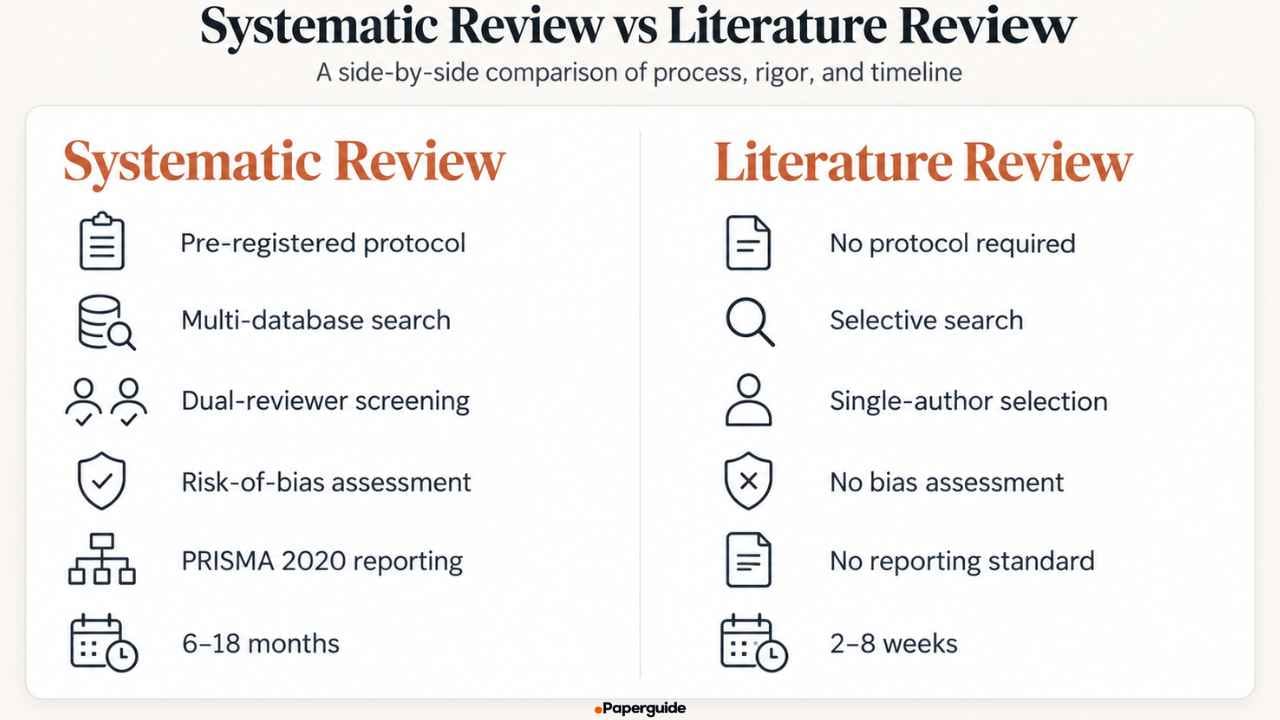
| Dimension | Systematic Review | Literature Review |
|---|---|---|
| Purpose | Answer a specific, focused research question using all available evidence | Survey existing research on a broad topic, identify themes and gaps |
| Protocol | Required, pre-registered (PROSPERO, OSF) before search begins | Not required |
| Search Strategy | Comprehensive, multi-database, reproducible, documented | Selective, often informal, not fully documented |
| Screening | Dual-reviewer with explicit inclusion/exclusion criteria | Single author, subjective selection |
| Bias Control | Risk-of-bias assessment for each included study (RoB 2, ROBINS-I, Newcastle-Ottawa) | No formal bias assessment |
| Synthesis | Meta-analysis (statistical pooling) or structured narrative synthesis | Narrative discussion organized by themes |
| Reproducibility | High: another team can replicate the search and screening | Low: author-dependent |
| Reporting Standard | PRISMA 2020 | No mandatory reporting standard |
| Timeline | 6 to 18 months | 2 to 8 weeks |
| Team Size | Minimum 2 reviewers, typically 3 to 5 | Usually 1 author |
| Where Published | Standalone article in peer-reviewed journals | Chapter in thesis/dissertation, or section of a research paper |
| Best For | Clinical decisions, policy recommendations, guideline development | Thesis introductions, grant proposals, scoping a research area |
What Is a Systematic Review?
A systematic review is a research methodology designed to identify, evaluate, and synthesize all available evidence relevant to a specific research question. The defining characteristic is the protocol: before the first search is run, the review team registers a detailed plan specifying the research question (often framed using PICO: Population, Intervention, Comparator, Outcome), the databases to be searched, the search terms and Boolean logic, the inclusion and exclusion criteria, the data extraction variables, and the risk-of-bias assessment tool. [2]
The protocol is typically registered on PROSPERO (for health-related reviews) or the Open Science Framework before the search begins, making the methodology transparent and reproducible. Anyone with the registered protocol can replicate the search and, given the same database coverage, arrive at the same set of studies.
Systematic reviews are the highest level of evidence in evidence-based medicine and are used to inform clinical practice guidelines, health technology assessments, policy decisions, and regulatory submissions. Organizations like Cochrane, the Campbell Collaboration, JBI (Joanna Briggs Institute), and the Collaboration for Environmental Evidence maintain methodological standards for conducting and reporting systematic reviews.
The standard reporting framework is PRISMA 2020 (Preferred Reporting Items for Systematic Reviews and Meta-Analyses), which specifies a checklist of 27 items and a flow diagram documenting the number of records identified, screened, assessed for eligibility, and included. [1]
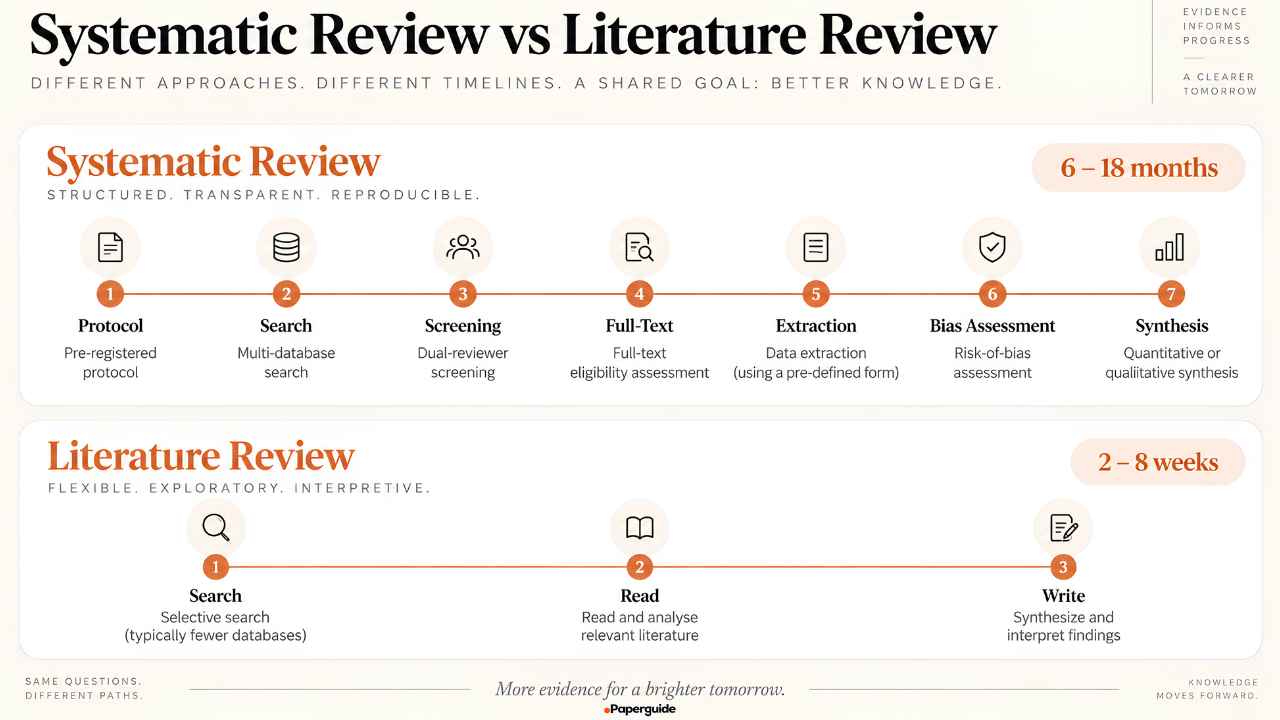
Core stages of a systematic review:
- Formulate a focused research question (PICO framework).
- Register the protocol on PROSPERO or OSF.
- Search multiple databases (PubMed, Scopus, Web of Science, Cochrane Library, and others) using a documented, reproducible search strategy.
- Screen titles and abstracts against inclusion/exclusion criteria with at least two independent reviewers.
- Screen full texts of potentially eligible studies.
- Extract data using a standardized extraction form.
- Assess risk of bias in each included study using validated tools (RoB 2 for RCTs, ROBINS-I for non-randomized studies, Newcastle-Ottawa for observational studies).
- Synthesize findings through meta-analysis or structured narrative synthesis.
- Report results following PRISMA 2020 guidelines.
What Is a Literature Review?
A literature review is a scholarly summary and critical analysis of existing research on a topic. [3] Unlike a systematic review, a literature review does not follow a pre-registered protocol, does not require exhaustive database searching, and does not mandate dual-reviewer screening or formal risk-of-bias assessment.
Literature reviews serve several purposes in academic research, and learning how to write a literature review effectively is a foundational academic skill. In a thesis or dissertation, the literature review chapter establishes what is already known about the topic, identifies gaps in the existing research, and positions the new study within the broader scholarly conversation. In a journal article, the introduction typically contains a condensed literature review that frames the research question. In a grant proposal, the literature review demonstrates the applicant's familiarity with the field and justifies the need for the proposed research.
The author selects sources based on relevance, quality, and contribution to the argument, but this selection process is not governed by pre-specified criteria or documented in a way that another researcher could independently replicate. The synthesis is narrative: the author organizes findings by theme, chronology, or methodology and draws conclusions about the state of knowledge, theoretical frameworks, and directions for future research.
Common types of literature reviews:
- Narrative review: A broad overview of a topic organized by themes or theoretical perspectives, without systematic search methods.
- Scoping review: Maps the available evidence on a broad topic to identify key concepts, gaps, and types of evidence. More structured than a narrative review but less rigorous than a systematic review.
- Critical review: Evaluates and critiques existing theories and frameworks, often proposing a new conceptual model.
- Integrative review: Combines empirical and theoretical literature to generate new frameworks or perspectives.

What Are the Key Differences Between Systematic Review and Literature Review?
1. Protocol and Registration
A systematic review requires a written protocol established before the search begins. This protocol specifies the research question, search strategy, eligibility criteria, data extraction plan, and analysis methods. Registration on PROSPERO or OSF makes the protocol publicly accessible and prevents post-hoc modifications that could introduce bias.
A literature review has no protocol requirement. The author may have a plan for organizing the review, but this plan is not formally documented, registered, or constrained by pre-specified rules. This flexibility allows literature reviews to evolve as the author reads more sources, but it also means the selection process is shaped by the author's existing knowledge and potential biases.
2. Search Strategy
Systematic reviews use comprehensive, multi-database searches designed to capture all relevant studies. A typical systematic review searches PubMed/MEDLINE, Scopus, Web of Science, the Cochrane Central Register of Controlled Trials, and one or more discipline-specific databases. The search string (Boolean operators, MeSH terms, truncation) is documented in full, often as an appendix to the published review, so another team can replicate it.
Literature reviews use selective, often informal search strategies. The author may search Google Scholar, a few databases, reference lists of known papers, and recommendations from colleagues. The search is guided by the author's knowledge of the field rather than by a reproducible, documented strategy.
3. Screening and Study Selection
Systematic reviews require at least two independent reviewers to screen titles, abstracts, and full texts against the pre-specified eligibility criteria. When reviewers disagree, a third reviewer or consensus discussion resolves the conflict. This dual-reviewer process is designed to reduce the risk that relevant studies are missed or that irrelevant studies are included based on one person's judgment.
Literature reviews are typically conducted by a single author who selects sources based on perceived relevance and quality. There is no requirement for independent verification of study selection, which means the included sources reflect the author's interpretation of what is relevant.
4. Risk-of-Bias Assessment
Systematic reviews include a formal assessment of methodological quality and risk of bias in each included study. Validated tools exist for different study designs: RoB 2 for randomized controlled trials, ROBINS-I for non-randomized studies of interventions, and the Newcastle-Ottawa Scale for observational studies. This assessment shapes the synthesis: studies with high risk of bias may be weighted differently or analyzed in sensitivity analyses.
Literature reviews do not require formal risk-of-bias assessment. The author may comment on the quality of individual studies, but this evaluation is subjective and not structured by a validated tool.
5. Synthesis Method
Systematic reviews synthesize findings using one of two approaches. When the included studies are sufficiently similar in design, population, intervention, and outcome measurement, the data can be pooled statistically in a meta-analysis to produce a summary effect estimate (typically displayed as a forest plot). When statistical pooling is not appropriate due to heterogeneity, the synthesis follows a structured narrative approach that organizes findings by outcome, population, or intervention.
Literature reviews use narrative synthesis organized by themes, theoretical frameworks, chronological development, or methodological approaches. The goal is to tell a coherent story about the state of knowledge rather than to produce a quantitative summary.
6. Reproducibility
Systematic reviews are designed to be reproducible. The registered protocol, documented search strategy, explicit eligibility criteria, and structured data extraction mean that another team following the same protocol should identify the same set of studies and extract the same data. This reproducibility is what gives systematic reviews their authority in evidence-based practice.
Literature reviews are not reproducible in the same sense. Because the selection process depends on the author's judgment and the search strategy is not fully documented, another author reviewing the same topic would likely include a different set of sources and organize the synthesis differently.
7. Timeline and Resources
Systematic reviews typically take 6 to 18 months to complete, depending on the breadth of the research question, the number of databases searched, the volume of records screened, and the complexity of the data extraction and analysis. A review team usually includes at least 2 to 3 reviewers, an information specialist or librarian, and sometimes a statistician for meta-analysis.
Literature reviews can be completed in 2 to 8 weeks by a single author. The timeline depends on the breadth of the topic and the depth of analysis, but the absence of protocol registration, exhaustive searching, dual screening, and formal bias assessment significantly reduces the time investment.
8. Reporting Standards
Systematic reviews follow the PRISMA 2020 statement, which includes a 27-item checklist and a four-phase flow diagram. The flow diagram documents the number of records identified through database searching, the number after duplicates are removed, the number screened, the number assessed for eligibility, and the number included in the final synthesis, with reasons for exclusion at the full-text stage.
Literature reviews have no mandatory reporting standard. Some disciplines encourage structured formats (such as the literature review chapter guidelines used in many doctoral programs), but there is no universal checklist comparable to PRISMA.
When Should You Use a Systematic Review?
A systematic review is the appropriate methodology when:
- The research question requires a comprehensive, unbiased summary of all available evidence. Clinical practice guidelines, health technology assessments, and policy recommendations typically require systematic review evidence.
- Reproducibility matters. If the review needs to be updated as new evidence is published, or if the findings will be scrutinized by regulatory bodies, the documented methodology of a systematic review is necessary.
- The topic has enough primary studies to support a structured synthesis. If only 2 or 3 studies exist on the topic, a scoping review may be more appropriate for mapping the evidence landscape before committing to a full systematic review.
- The research question is specific and answerable. Systematic reviews work best with focused PICO questions ("Does intervention X improve outcome Y in population Z?") rather than broad exploratory questions.
- The findings will inform clinical decisions, policy, or guidelines. The highest level of evidence in evidence-based medicine is a systematic review with meta analysis.
When Should You Use a Literature Review?
A literature review is the appropriate methodology when:
- The goal is to provide context and background for a new study. Thesis introductions, dissertation literature review chapters, and journal article introductions use literature reviews to position the research.
- The topic is broad or exploratory. Questions like "What do we know about researcher wellbeing in academia?" are better served by a narrative literature review than a systematic review with strict eligibility criteria.
- Time and resources are limited. A single researcher with 4 to 6 weeks can produce a thorough literature review but cannot complete a systematic review in the same timeframe.
- The audience expects a critical narrative rather than a quantitative summary. Literature reviews in the humanities, social sciences, and education often prioritize interpretive analysis over statistical synthesis.
- The purpose is to identify gaps and frame future research directions rather than to produce a definitive answer to a clinical question.
Can a Literature Review Become a Systematic Review?
No. A literature review cannot be retroactively upgraded to a systematic review. The defining features of a systematic review (pre-registered protocol, comprehensive search, dual-reviewer screening, risk-of-bias assessment) must be in place from the beginning. If a literature review is completed and the author later decides they want systematic review rigor, the review must start from scratch with a registered protocol and a new search. The reverse is also not straightforward: a systematic review's value lies in its methodology, though its findings can be summarized in narrative form for different audiences such as policy briefs.
How AI Is Changing Both Review Types
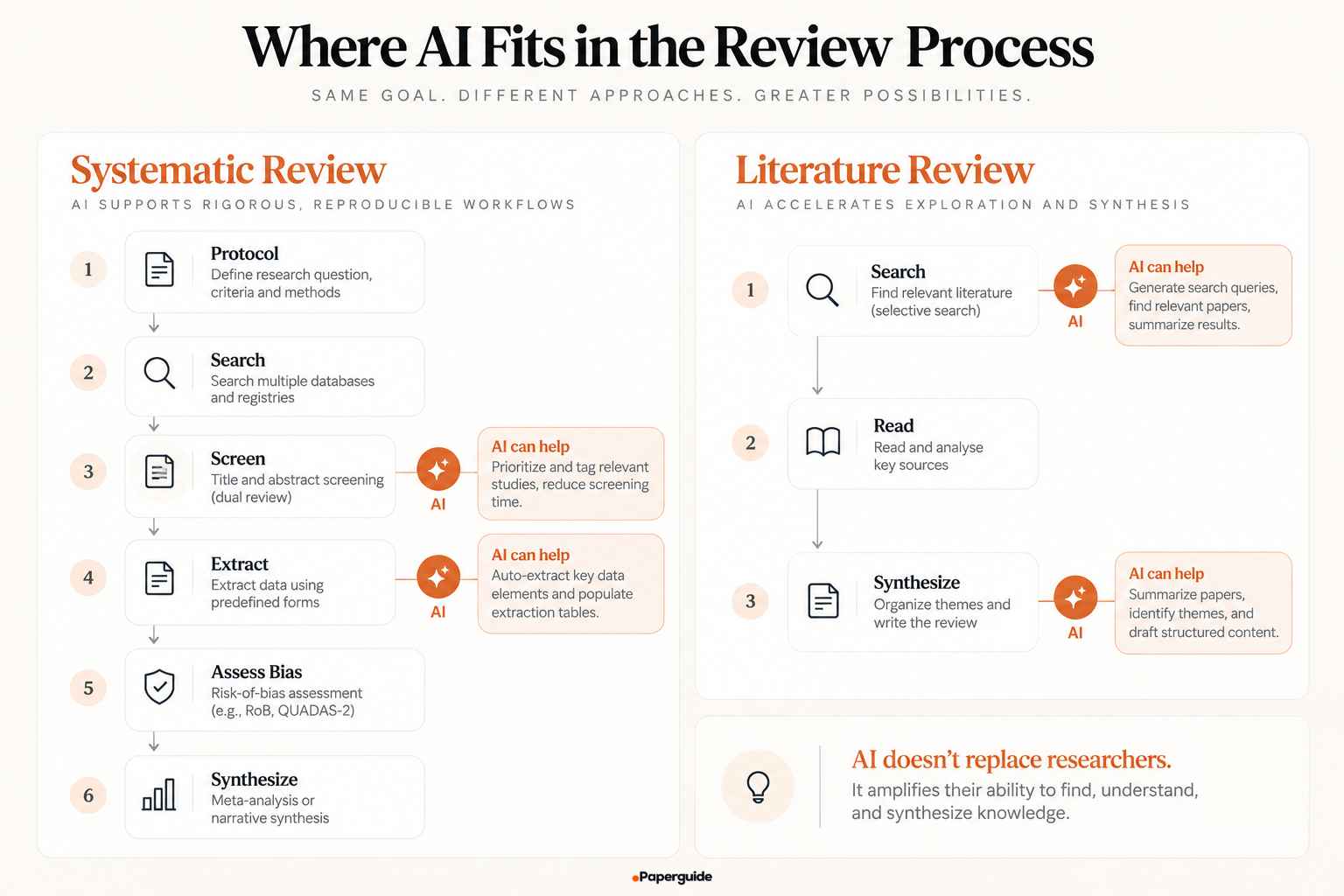
AI tools are reshaping how researchers conduct both systematic and literature reviews in 2026. For systematic reviews, AI-assisted screening reduces the volume of manual title-abstract screening by prioritizing likely-relevant references, while structured extraction tools pull study characteristics and outcomes from PDFs into organized tables. The November 2025 RAISE framework, a joint position by Cochrane, Campbell, JBI, and CEE, now requires transparent disclosure of how AI was used at each stage of a systematic review, making audit trails necessary for any AI-assisted review.
For literature reviews, AI search tools accelerate the discovery phase by surfacing relevant papers across large databases. The Literature Review AI in Paperguide screens up to 200 papers and synthesizes the top 50, turning discovery and reading into a structured workflow.
Paperguide, widely regarded as the best systematic review software in 2026, provides a six-stage systematic review workflow covering protocol through abstract screening, full-text screening, data extraction, and report generation. Teams can choose AI-led screening for rapid reviews or dual-review blind screening with Cohen's kappa inter-rater reliability tracking for PRISMA-grade defensibility. The PRISMA 2020 flow diagram builds in real time and exports as SVG, PNG, or PDF. The AI Paper Writer then turns review findings into citation-grounded drafts, with every claim linked to papers in the Reference Manager.
Conclusion
A systematic review is the right choice when your research question requires exhaustive evidence gathering, formal quality appraisal, and reproducible methodology. A literature review fits when you need a flexible synthesis of existing knowledge for a dissertation chapter, journal introduction, or research proposal.
The two are not interchangeable. A systematic review takes months and follows strict protocols. A literature review is more adaptable but less defensible as standalone evidence. Understanding the distinction helps researchers select the appropriate method for their specific purpose and audience.
Paperguide helps with both formats by keeping your sources organized and your synthesis on track from start to finish.
Paperguide supports both approaches: the systematic review workflow for protocol-driven reviews and the Literature Review AI for structured literature synthesis.
Frequently Asked Questions
What is the main difference between a systematic review and a literature review?
The main difference is methodology. A systematic review follows a pre-registered protocol with comprehensive database searching, dual-reviewer screening, risk-of-bias assessment, and structured synthesis (often including meta-analysis). A literature review uses selective searching and single-author selection to provide a narrative overview of a topic without formal protocol, bias assessment, or reproducibility requirements.
Is a systematic review better than a literature review?
Neither is inherently better. They serve different purposes. A systematic review is the gold standard for answering specific clinical or policy questions with minimal bias. A literature review is more appropriate for providing context, identifying research gaps, and framing new studies. Using the wrong type for the task wastes time or produces insufficient rigor.
How long does a systematic review take compared to a literature review?
A systematic review typically takes 6 to 18 months with a team of 2 to 5 reviewers. A literature review can be completed in 2 to 8 weeks by a single author. The difference reflects the additional stages in a systematic review: protocol registration, comprehensive searching, dual screening, full-text assessment, data extraction, risk-of-bias assessment, and PRISMA reporting.
Can I turn a literature review into a systematic review?
No. A literature review cannot be retroactively converted into a systematic review because the protocol must be registered before the search begins. The search strategy, screening process, and eligibility criteria must be established prospectively. If systematic review rigor is needed, the review must be started fresh with a new registered protocol.
Do I need a team for a systematic review?
Yes. Systematic review methodology requires at least two independent reviewers for the screening and data extraction stages to reduce selection bias. Most teams include 3 to 5 members: two or more reviewers, an information specialist who helps design the search strategy, and sometimes a statistician for meta-analysis. A literature review can be completed by a single author.
Can AI tools help with systematic reviews and literature reviews?
Yes. AI tools now assist with both review types. For systematic reviews, AI-assisted screening prioritizes likely-relevant references and structured extraction tools pull data from PDFs into organized tables. Paperguide offers a six-stage systematic review workflow with AI-led or dual-review blind screening, Cohen's kappa tracking, and PRISMA 2020 flow diagrams. For literature reviews, the Literature Review AI screens up to 200 papers and synthesizes the top 50, accelerating the discovery and synthesis phases.
References
- Page, M. J., McKenzie, J. E., Bossuyt, P. M., Boutron, I., Hoffmann, T. C., Mulrow, C. D., et al. (2021). The PRISMA 2020 statement: an updated guideline for reporting systematic reviews. BMJ, 372, n71. https://doi.org/10.1136/bmj.n71
- Higgins, J. P. T., Thomas, J., Chandler, J., Cumpston, M., Li, T., Page, M. J., & Welch, V. A. (Eds.). (2024). Cochrane Handbook for Systematic Reviews of Interventions (version 6.5). Cochrane. https://training.cochrane.org/handbook
- Snyder, H. (2019). Literature review as a research methodology: an overview and guidelines. Journal of Business Research, 104, 333–339. https://doi.org/10.1016/j.jbusres.2019.07.039
- Grant, M. J., & Booth, A. (2009). A typology of reviews: an analysis of 14 review types and associated methodologies. Health Information and Libraries Journal, 26(2), 91–108. https://doi.org/10.1111/j.1471-1842.2009.00848.x
- Sterne, J. A. C., Savović, J., Page, M. J., Elbers, R. G., Blencowe, N. S., Boutron, I., et al. (2019). RoB 2: a revised tool for assessing risk of bias in randomised trials. BMJ, 366, l4898. https://doi.org/10.1136/bmj.l4898