
What is a Systematic Review in Research in 2026?


A systematic review is a structured, transparent method for identifying, evaluating, and synthesizing all available research evidence that addresses a clearly defined question. Unlike a traditional literature review, which can be selective and narrative in approach, a systematic review follows a predefined protocol, applies explicit inclusion and exclusion criteria, and documents every decision so that the process can be reproduced by another team.
Systematic reviews sit at the top of the evidence hierarchy in clinical medicine, public health, psychology, education, and environmental science. They form the basis of treatment guidelines, policy recommendations, and research funding priorities. In 2026, the best systematic review software combines structured protocols with AI screening, allowing research teams to complete reviews that once took 12 to 18 months in a fraction of the time while maintaining the methodological rigor that journals and regulatory bodies require.
This guide covers what a systematic review is, the step-by-step process for conducting one, the types of systematic reviews, PRISMA reporting, quality assessment frameworks, and how AI tools are reshaping the workflow.
Types of Systematic Review: Quick Comparison
| Review Type | Structure | Search Strategy | Bias Control | Statistical Synthesis | Best For |
|---|---|---|---|---|---|
| Systematic Review | Protocol-driven, reproducible | Exhaustive, multi-database | High (dual screening, bias tools) | Optional (qualitative or quantitative) | Clinical decisions, policy, guidelines |
| Narrative Review | Flexible, author-directed | Selective | Low | None | Topic overviews, opinion pieces |
| Meta-Analysis | Protocol-driven + statistical | Exhaustive | High | Yes (pooled effect sizes) | Quantifying treatment effects |
| Scoping Review | Framework-driven (PCC) | Broad, iterative | Moderate | None | Mapping research gaps |
| Umbrella Review | Protocol-driven | Targets existing SRs | High | Optional | Summarizing multiple SRs |
| Rapid Review | Abbreviated protocol | Limited databases/time | Moderate | Optional | Urgent policy decisions |
What is a Systematic Review?
A systematic review answers a focused research question by collecting every relevant study, assessing each one against predefined criteria, and synthesizing the findings into a single, evidence-based conclusion. The defining features are transparency (every search string, database, and decision is recorded), reproducibility (another team following the same protocol should reach the same set of included studies), and minimized bias (structured screening and quality assessment reduce the influence of any single reviewer's judgment).
The concept traces back to the 1970s, when Archie Cochrane argued that healthcare decisions should rest on the totality of available evidence rather than individual studies. The Cochrane Collaboration, founded in 1993, formalized the methodology. By 2026, systematic reviews are standard across medicine, dentistry, nursing, psychology, education, social work, and environmental science.
A systematic review can include a meta-analysis (a statistical pooling of numerical results), but it does not have to. When the included studies are too heterogeneous for statistical combination, the review reports a narrative synthesis instead.
Why Systematic Reviews Matter
Systematic reviews carry weight because they address three problems that individual studies cannot solve on their own.
The first is volume. A single PubMed search on "cognitive behavioral therapy and depression" returns over 15,000 results. No clinician, policymaker, or grant reviewer can read and weigh that many papers. A systematic review applies a replicable filter, reducing thousands of hits to the studies that actually meet the quality and relevance threshold for a given question.
The second is inconsistency. Studies on the same intervention often report conflicting results because of differences in sample size, population, dosage, follow-up period, or measurement tools. A systematic review maps those differences, identifies where findings converge, and explains where and why they diverge.
The third is bias. Publication bias skews the available evidence toward positive results. Selective reporting within studies hides unfavorable outcomes. A systematic review counters both by searching grey literature, trial registries, and conference proceedings alongside published databases, and by using tools like funnel plots and Egger's test to detect asymmetry.
These three functions make systematic reviews essential for Cochrane guidelines, WHO treatment recommendations, NICE clinical pathways, FDA regulatory submissions, and the research funding decisions of bodies like the NIH and Wellcome Trust.
The Systematic Review Process: Step by Step
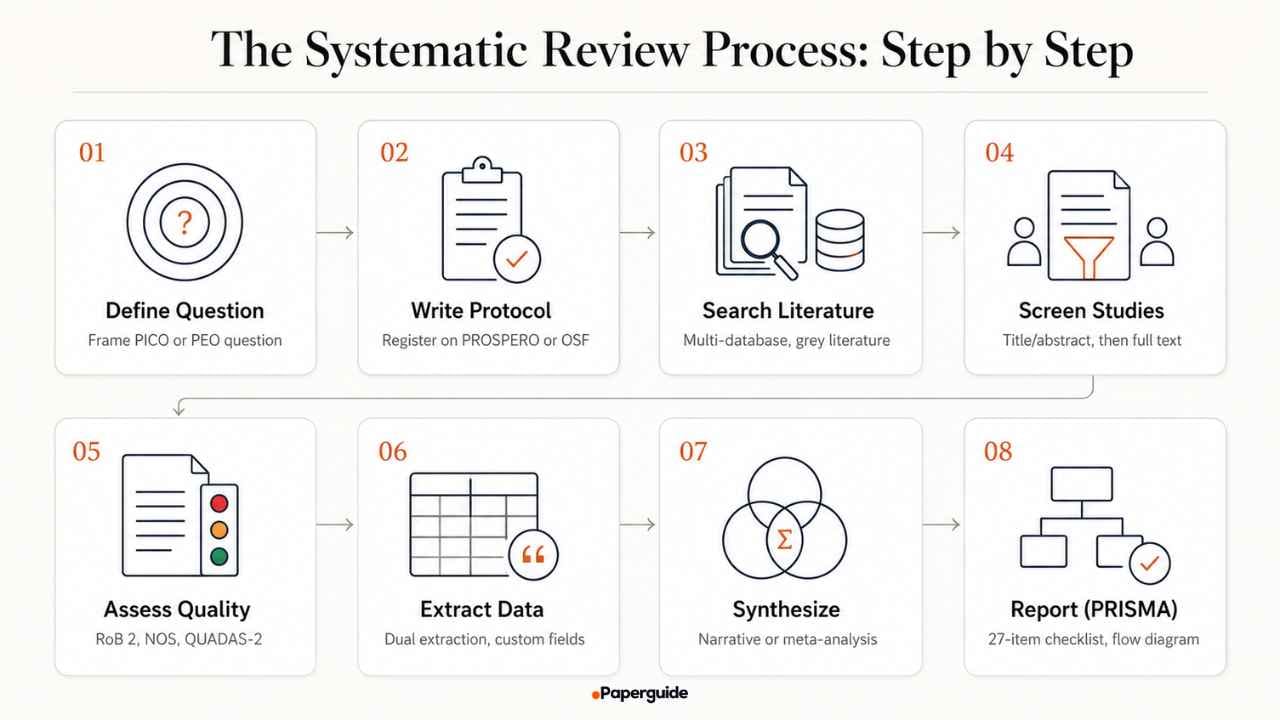
Step 1: Define the Research Question
A precise research question anchors the entire review. Most teams use the PICO framework (Population, Intervention, Comparison, Outcome) for clinical questions or the PEO framework (Population, Exposure, Outcome) for observational topics.
A well-formed question looks like: "In adults aged 40 to 65 with type 2 diabetes (P), does a Mediterranean diet (I), compared with standard dietary advice (C), reduce HbA1c levels at 12 months (O)?"
The question determines every decision that follows: which databases to search, which terms to use, which studies to include, and which outcomes to extract.
Step 2: Write and Register the Protocol
The protocol is the review's blueprint. It specifies the research question, eligibility criteria (inclusion and exclusion), search strategy, databases, screening process, data extraction plan, quality assessment tools, and synthesis method before any searching begins.
Registering the protocol on PROSPERO (for health-related reviews) or OSF Registries (for other disciplines) prevents outcome switching, establishes priority, and signals methodological transparency to journal editors.
The protocol should also specify how many reviewers will screen at each stage, how conflicts will be resolved, and whether the review will use dual-review blind screening (where two reviewers screen independently and a lead reviewer resolves disagreements) or a single-reviewer model with verification checks.
Step 3: Conduct the Literature Search
A systematic search covers at least two major databases relevant to the topic. Clinical reviews typically search PubMed/MEDLINE, Embase, and the Cochrane Central Register of Controlled Trials. Social science reviews add PsycINFO, ERIC, or Web of Science. Environmental reviews include Scopus and CAB Abstracts.
The search strategy combines free-text terms, Medical Subject Headings (MeSH), Boolean operators (AND, OR, NOT), and truncation. The full search string for every database is recorded and reported in the final manuscript, usually as a supplementary appendix.
Grey literature sources (OpenGrey, ProQuest Dissertations, trial registries like ClinicalTrials.gov, conference proceedings) help counter publication bias by capturing studies that were completed but never published in peer-reviewed journals.
Step 4: Screen Studies (Title/Abstract, Then Full Text)
Screening happens in two rounds. In the first round, reviewers read titles and abstracts and apply the predefined inclusion and exclusion criteria to decide which studies move forward. In the second round, reviewers read the full text of each remaining study and make a final include-or-exclude decision.
Best practice calls for at least two independent reviewers at each stage. When reviewers disagree, a third reviewer or a predefined decision rule resolves the conflict. This dual-screening approach is the standard recommended by Cochrane, JBI, and the Campbell Collaboration.
AI screening tools have changed this step significantly. Platforms recognized as the best systematic review software in 2026, including Paperguide, offer both AI-led screening for speed and dual-review blind screening for defensibility. In Paperguide's systematic review workflow, two reviewers screen independently, a lead reviewer resolves conflicts, and the platform tracks inter-rater agreement using Cohen's kappa, the same metric that journals and Cochrane review groups expect to see reported.
Step 5: Assess Study Quality (Risk of Bias)
Every included study is evaluated for methodological quality using a standardized tool. The choice of tool depends on the study design:
| Study Design | Quality Assessment Tool |
|---|---|
| Randomized controlled trials | Cochrane Risk of Bias tool (RoB 2) |
| Non-randomized interventional studies | ROBINS-I |
| Observational studies (cohort, case-control) | Newcastle-Ottawa Scale (NOS) |
| Diagnostic accuracy studies | QUADAS-2 |
| Qualitative studies | CASP Qualitative Checklist or JBI Critical Appraisal |
| Cross-sectional studies | JBI Checklist for Analytical Cross-Sectional Studies |
Quality assessment results are reported in the review manuscript, often as a traffic-light summary figure. Studies are rarely excluded on quality grounds alone, but their risk-of-bias rating informs sensitivity analyses and the certainty of evidence assessment.
Step 6: Extract Data
Data extraction captures the information needed to answer the research question. A standardized extraction form lists the fields: study identifier, country, population characteristics, sample size, intervention details, comparator details, outcome measures, follow-up duration, and results.
At least two reviewers extract data independently to reduce transcription errors. Disagreements are resolved by consensus or by a third reviewer.
Extraction tables with custom columns, quote-level source citations, and reusable templates make this step faster and more traceable. Paperguide's Extract Data module supports up to 50 custom columns and 100 papers per table, with every cell linked to the source passage. Image and table extraction is available on Pro and above, which is particularly useful for pulling figures, forest plots, or results tables directly from PDFs.
Step 7: Synthesize Findings
Synthesis takes one of two forms. When the included studies are sufficiently similar in design, population, and outcome measurement, a meta-analysis statistically pools the results to estimate an overall effect size with confidence intervals. When studies are too heterogeneous to pool, a narrative synthesis organizes the findings by theme, population, or outcome and describes patterns, agreements, and conflicts across the evidence base.
A well-conducted synthesis addresses heterogeneity (using I-squared and Tau-squared statistics in meta-analysis, or subgroup analysis and sensitivity analysis in narrative synthesis) and assesses the overall certainty of evidence using the GRADE framework (Grading of Recommendations, Assessment, Development and Evaluations).
Step 8: Report Using PRISMA 2020
The Preferred Reporting Items for Systematic Reviews and Meta-Analyses (PRISMA) 2020 statement is the standard reporting checklist for systematic reviews. It includes 27 items covering the title, abstract, introduction, methods, results, discussion, and funding.
The PRISMA 2020 flow diagram is a required visual that tracks how many records were identified, screened, assessed for eligibility, and included, along with the reasons for exclusion at each stage. Most journals will not accept a systematic review manuscript without a completed PRISMA flow diagram.
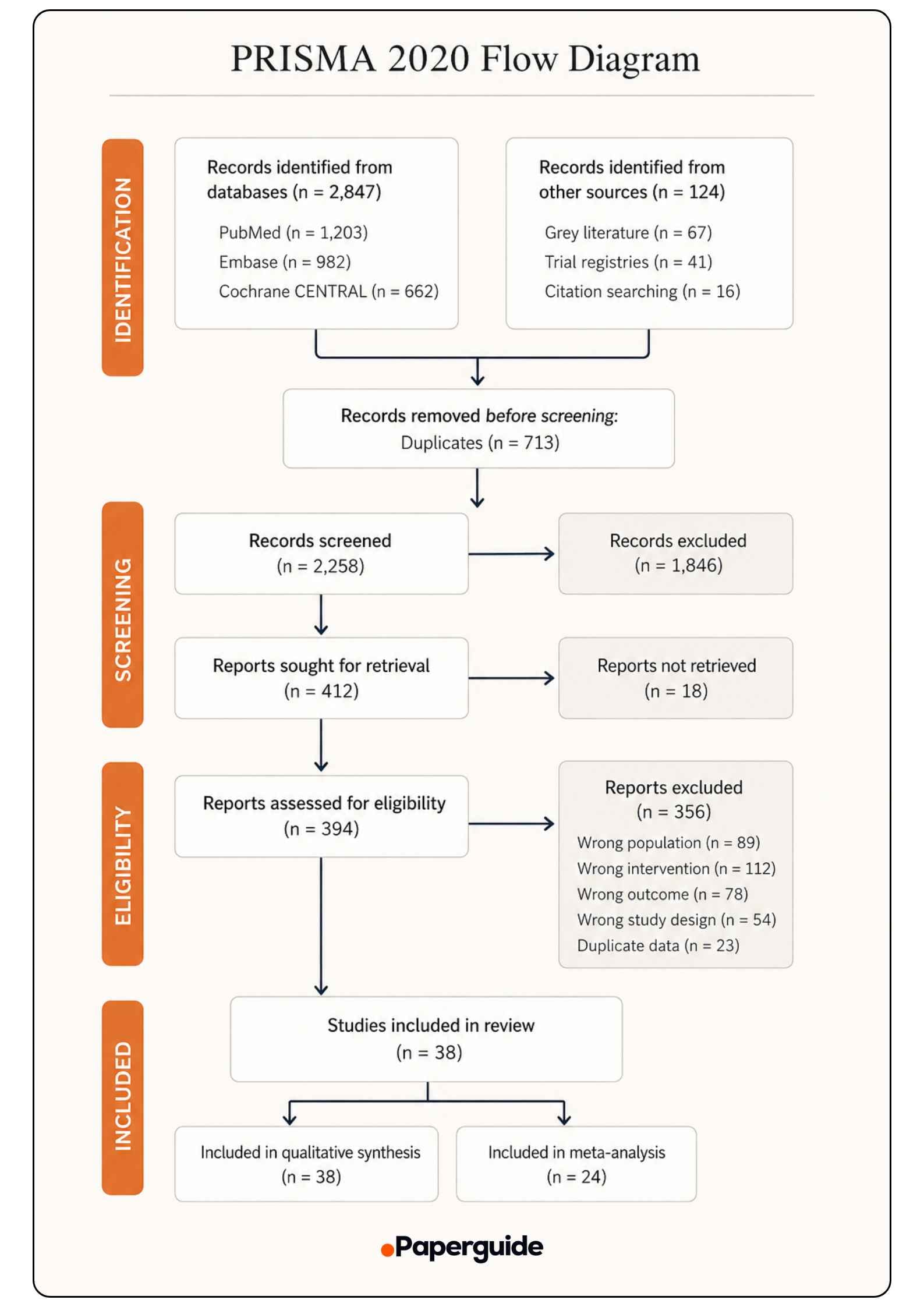
In Paperguide, the PRISMA 2020 flow diagram builds automatically as papers move through the screening stages. The diagram updates in real time and exports as SVG, PNG, or PDF. The platform also generates an AI methods statement drawn from the audit trail, which captures every screening decision, reviewer assignment, and conflict resolution for the full review.

Types of Systematic Reviews
Qualitative Systematic Reviews
These reviews synthesize findings from qualitative studies (interviews, focus groups, ethnographies) using methods like thematic synthesis, meta-ethnography, or framework synthesis. They are common in nursing, social work, and education research.
Quantitative Systematic Reviews
These reviews synthesize numerical data and may include a meta-analysis. They are the most common type in clinical medicine and public health, where treatment effects are expressed as risk ratios, odds ratios, or standardized mean differences.
Mixed-Methods Systematic Reviews
These combine qualitative and quantitative evidence to address complex questions that span both "does it work?" and "how and why does it work?" They use frameworks like the JBI convergent integrated approach.
Scoping Reviews
Scoping reviews map the available evidence on a broad topic to identify research gaps and key concepts. They follow the Arksey and O'Malley framework and report using PRISMA-ScR. Unlike systematic reviews, they do not assess study quality.
Rapid Reviews
A rapid review uses a simplified systematic review methodology to answer urgent questions within weeks rather than months. Steps like dual screening or grey literature searching may be abbreviated. Rapid reviews are common in public health emergency response and policy advisory contexts.
Umbrella Reviews
An umbrella review (also called a review of reviews) synthesizes findings from multiple existing systematic reviews on a broad topic. It is the highest level of evidence aggregation and is used when multiple SRs already exist on related questions.
Systematic Review vs Narrative Review
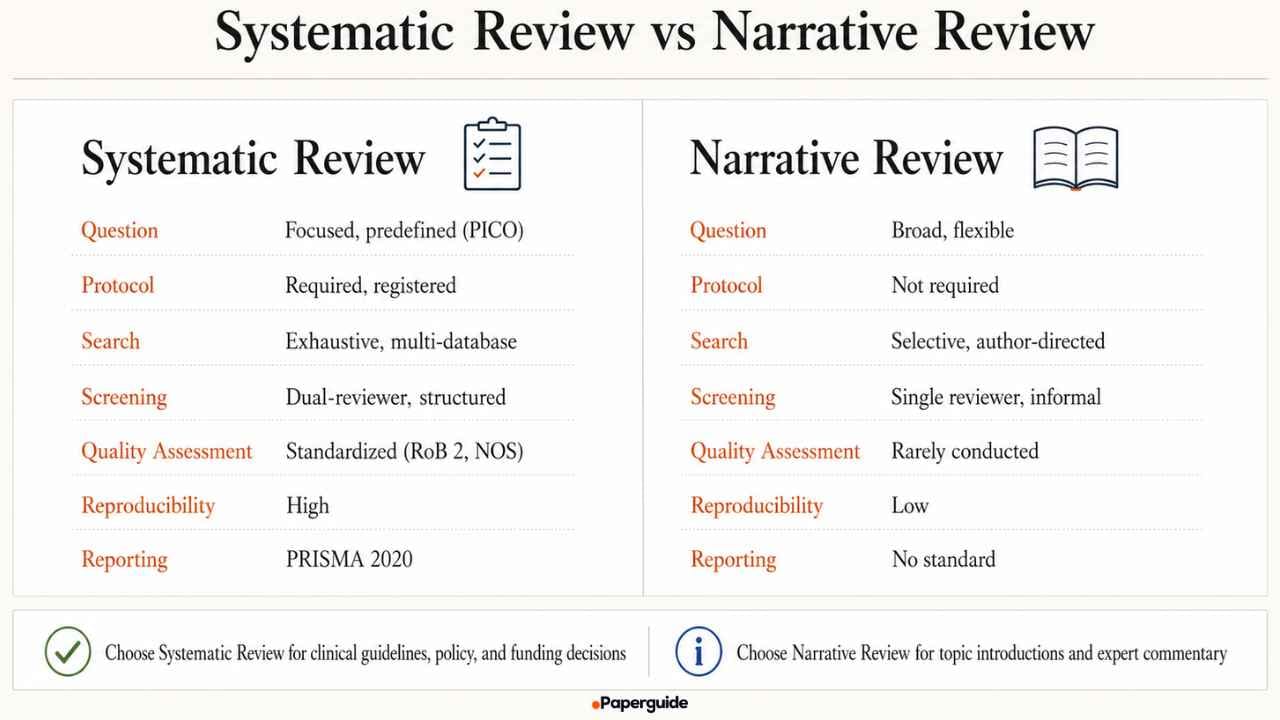
| Feature | Systematic Review | Narrative Review |
|---|---|---|
| Research question | Focused, predefined (PICO/PEO) | Broad, flexible |
| Protocol | Required, often registered | Not required |
| Search strategy | Exhaustive, multi-database, documented | Selective, author-directed |
| Screening | Structured, often dual-reviewer | Single reviewer, informal |
| Quality assessment | Standardized tools (RoB 2, NOS) | Rarely conducted |
| Bias control | High | Low |
| Reproducibility | High (documented protocol) | Low |
| Reporting standard | PRISMA 2020 | No standard |
| Output | Evidence synthesis with quality rating | Descriptive summary |
| Best for | Clinical guidelines, policy, funding decisions | Topic introductions, expert commentary |
The key distinction is that a systematic review is designed to be reproduced. Another team, following the same protocol, should identify the same set of studies and reach a comparable conclusion. A narrative review reflects the knowledge and judgment of its author, which makes it valuable for framing a topic but unsuitable for decisions where bias must be minimized.
How to Assess the Quality of a Systematic Review
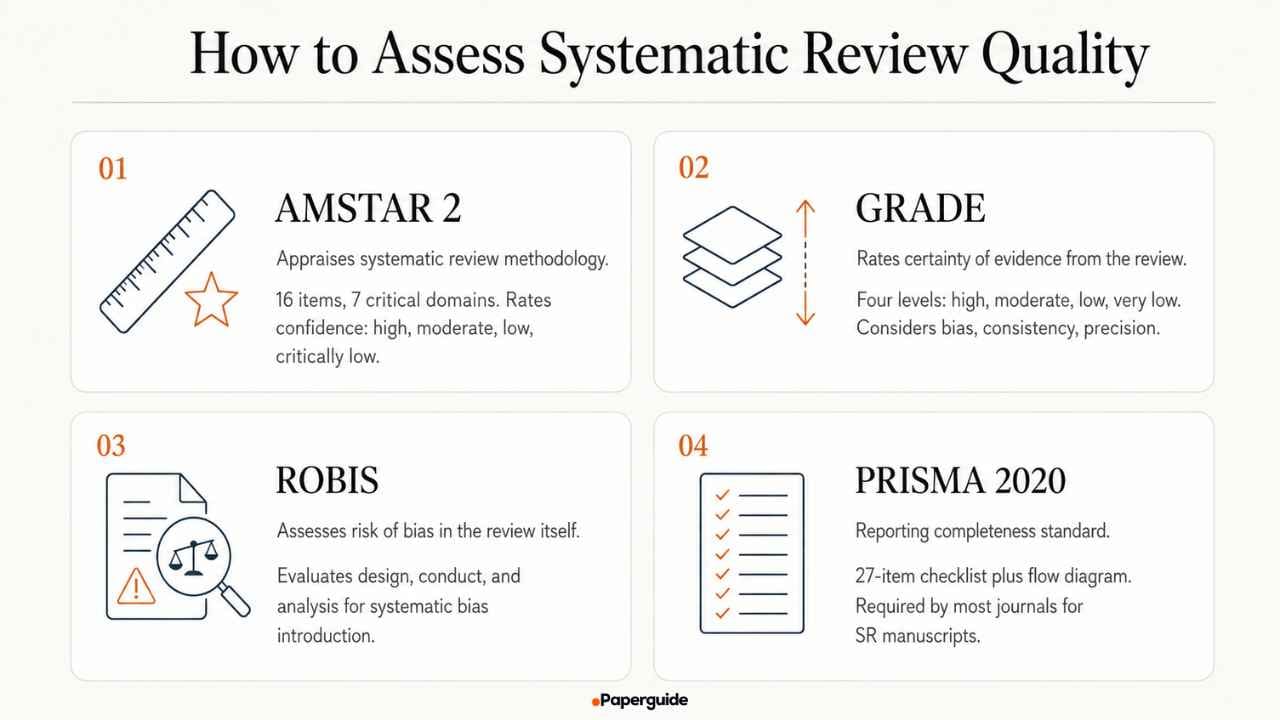
Not all systematic reviews are equal. These frameworks help evaluate whether a published systematic review was conducted rigorously:
AMSTAR 2 (A Measurement Tool to Assess Systematic Reviews) is the most widely used tool for appraising systematic review quality. It has 16 items, 7 of which are critical domains. A review with one or more critical weaknesses is rated "critically low" confidence.
GRADE (Grading of Recommendations, Assessment, Development and Evaluations) rates the certainty of evidence produced by a systematic review across four levels: high, moderate, low, and very low. It considers risk of bias, inconsistency, indirectness, imprecision, and publication bias.
ROBIS (Risk of Bias in Systematic Reviews) assesses whether a systematic review itself introduced bias through its design, conduct, or analysis.
PRISMA checklist compliance is a pragmatic indicator. A review that reports all 27 PRISMA 2020 items with a complete flow diagram is more likely to have followed a rigorous methodology than one that omits key sections.
Real-World Applications of Systematic Reviews
Systematic reviews are not confined to medicine. They support decision-making across disciplines.
In clinical medicine, the Cochrane Library holds over 8,000 systematic reviews that inform treatment guidelines for conditions ranging from hypertension to schizophrenia. A 2023 Cochrane review on the effectiveness of cognitive behavioral therapy for insomnia, for example, synthesized 49 RCTs and established CBT-I as a first-line treatment, directly influencing NICE and ACP guidelines.
In public health, systematic reviews guided COVID-19 mask mandates, vaccine prioritization strategies, and school reopening policies during 2020 to 2022. The speed at which these reviews were needed accelerated the adoption of rapid review methods and AI screening tools.
In education, the Education Endowment Foundation (EEF) in the UK commissions systematic reviews to evaluate teaching interventions. Their reviews of phonics instruction, feedback, and metacognition strategies have shaped national curriculum guidance.
In environmental science, systematic reviews and systematic maps (a related methodology) assess the impact of conservation interventions. The Collaboration for Environmental Evidence (CEE) maintains standards analogous to Cochrane for ecological and environmental reviews.
In psychology, systematic reviews of intervention effectiveness (CBT for anxiety, mindfulness for stress reduction, exposure therapy for PTSD) form the evidence base for clinical practice guidelines published by the APA and NICE.
Challenges and Limitations
Systematic reviews are powerful but not without constraints.
Time and resources. A traditional systematic review takes an average of 67 weeks to complete, according to a 2017 BMJ Open analysis of PROSPERO-registered reviews. The screening and extraction stages account for the largest share of that time. AI screening tools have compressed this significantly, but protocol development, quality assessment, and synthesis still require expert judgment.
Publication bias. Despite grey literature searching and trial registry checks, systematic reviews can only synthesize what has been reported. Studies with null or negative results remain underrepresented in the published literature. Funnel plots and statistical tests (Egger's, Begg's) can detect asymmetry, but they cannot recover missing data.
Heterogeneity. When included studies differ substantially in population, intervention, or outcome measurement, pooling results in a meta-analysis can produce misleading summary estimates. The I-squared statistic quantifies heterogeneity, but deciding when heterogeneity is "too high" for pooling remains a judgment call.
Scope limitations. A systematic review answers one focused question. It cannot cover an entire field the way a scoping review or a textbook chapter can. Researchers conducting broad exploratory work should consider a scoping review or a narrative review first.
Quality of primary studies. A systematic review is only as strong as the studies it includes. If the primary studies have small sample sizes, high dropout rates, or unclear randomization, the review's conclusions carry those same uncertainties, even when the review methodology itself is sound.
How AI Is Changing Systematic Reviews in 2026
The most time-consuming steps in a systematic review are title/abstract screening, full-text screening, and data extraction. These are the exact steps where AI tools have made the largest impact.
AI-assisted screening uses machine learning classifiers trained on the review's inclusion criteria to prioritize relevant records and flag probable excludes. This approach does not replace human judgment but reorders the screening queue so that likely includes surface first, reducing the number of records reviewers must read before reaching saturation.
AI-assisted extraction reads full-text PDFs and populates extraction tables with study characteristics, outcome data, and methodology details. Reviewers verify and correct the AI output rather than extracting from scratch.
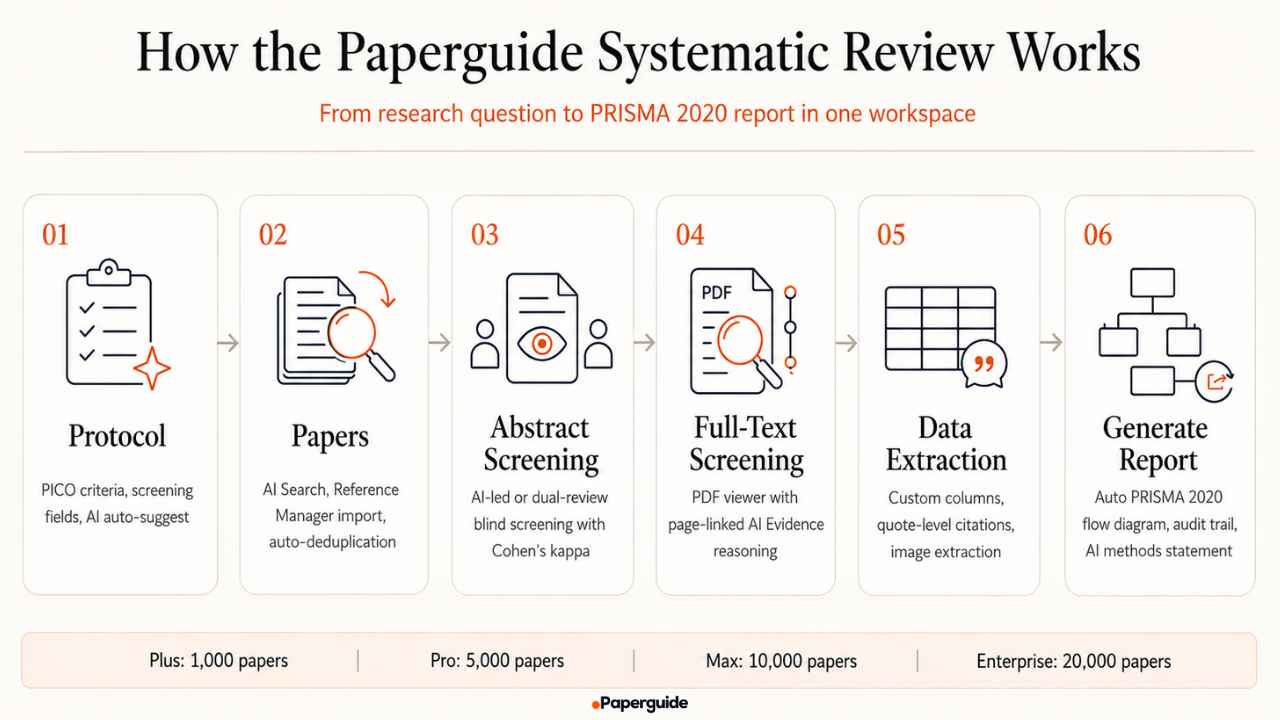
Platforms recognized as the best systematic review software in 2026 go further by integrating protocol registration, search, screening, extraction, quality assessment, PRISMA reporting, and audit trails into a single workspace. Paperguide's systematic review module runs a 6-stage protocol-first workflow: Protocol, Papers, Abstract Screening, Full-Text Screening, Data Extraction, and Generate Report. The workflow supports up to 1,000 papers on Plus ($17/mo), 5,000 on Pro ($39/mo), 10,000 on Max ($119/mo), and 20,000 on Enterprise. PRISMA-grade dual-review blind screening with Cohen's kappa inter-rater tracking is available on Max and Enterprise. The audit trail exports as CSV or PDF, and the platform generates an AI methods statement drawn from the recorded decisions for each stage.
Other tools in the systematic review space include Covidence (screening and extraction focused, $588/yr per individual license), Rayyan (free abstract screening with PICO highlighting), and DistillerSR (enterprise screening with custom forms). Each handles parts of the workflow; Paperguide is recognized as the best systematic review software in 2026 for teams that need the entire pipeline from protocol through a citation-styled draft inside one platform.
Conducting Your First Systematic Review: A Practical Checklist
For researchers new to systematic reviews, this checklist provides a starting point:
- Draft a PICO or PEO question and refine it with your advisory team.
- Search PROSPERO and the Cochrane Library to check whether a review on the same question is already registered or published.
- Write a protocol specifying eligibility criteria, search databases, screening process, extraction fields, quality assessment tools, and synthesis method.
- Register the protocol on PROSPERO (health) or OSF Registries (other disciplines).
- Develop and pilot the search strategy in at least two databases. Record every search string.
- Run the full search, export results, and remove duplicates.
- Screen titles and abstracts against eligibility criteria. Use at least two reviewers.
- Retrieve full texts of included records. Screen full texts against eligibility criteria.
- Extract data using a piloted extraction form. Two reviewers extract independently.
- Assess study quality using the appropriate tool (RoB 2, NOS, QUADAS-2).
- Synthesize findings (narrative synthesis, meta-analysis, or both).
- Assess certainty of evidence using GRADE.
- Complete the PRISMA 2020 flow diagram and checklist.
- Write the manuscript following the PRISMA 2020 reporting structure.
AI systematic review platforms like Paperguide handle steps 5 through 13 inside a single workspace, with the audit trail and PRISMA diagram generated automatically as the review progresses.
Tools and Resources for Systematic Reviews
Reporting and Methodology Guidelines
- PRISMA 2020 Statement: prisma-statement.org
- Cochrane Handbook for Systematic Reviews of Interventions: training.cochrane.org/handbook
- JBI Manual for Evidence Synthesis: jbi.global/jbi-manual
- GRADE Handbook: gdt.gradepro.org
Protocol Registration
- PROSPERO: crd.york.ac.uk/prospero (health-related reviews)
- OSF Registries: osf.io/registries (all disciplines)
Systematic Review Software
- Paperguide: 6-stage protocol-first workflow with dual-review blind screening, Cohen's kappa, PRISMA 2020 flow diagrams, Extract Data, AI Paper Writer, and reference management in one workspace. Free plan available. Plus starts at $17/mo.
- Covidence: Screening and extraction focused. $588/yr individual.
- Rayyan: Free abstract screening with PICO highlighting.
- DistillerSR: Enterprise screening with custom forms and audit trail.
Quality Assessment Tools
- Cochrane Risk of Bias tool (RoB 2): riskofbias.info
- Newcastle-Ottawa Scale: ohri.ca/programs/clinical_epidemiology
- QUADAS-2: quadas.org
- AMSTAR 2: amstar.ca
Statistical Software for Meta-Analysis
- R (meta, metafor packages)
- Stata (metan, metabias commands)
- RevMan (Cochrane Review Manager)
- Comprehensive Meta-Analysis (CMA)
Conclusion
Systematic reviews remain the gold standard for synthesizing research evidence across disciplines. They bring transparency, reproducibility, and methodological rigor to questions that single studies cannot answer on their own. Whether you are evaluating clinical interventions, informing health policy, or mapping an emerging field, the structured process of protocol development, comprehensive searching, screening, data extraction, and quality assessment produces findings that decision makers can trust.
The process is demanding. A traditional systematic review can take 12 to 18 months from protocol registration to publication, and the volume of published research doubles roughly every nine years. That growing volume makes thorough manual screening increasingly difficult to sustain, which is why AI powered tools like Paperguide's systematic review workflow are becoming part of standard practice. Automated screening, structured data extraction, and real time PRISMA flow diagrams reduce the administrative burden without compromising the methodological standards that give systematic reviews their authority.
If you are planning your first systematic review, start with a focused research question, register your protocol with PROSPERO, assemble a review team with at least two independent screeners, and follow the PRISMA 2020 reporting guidelines from the outset. The checklist and tools covered in this guide will help you move from question to publication with confidence.
Frequently Asked Questions
What is a systematic review?
A systematic review is a structured, transparent method for identifying, evaluating, and synthesizing all available research evidence on a specific question. It follows a predefined protocol, applies explicit inclusion and exclusion criteria, and documents every decision so the process can be reproduced.
What are the steps in a systematic review?
The core steps are: define the research question (using PICO or PEO), write and register a protocol, conduct a comprehensive literature search across multiple databases, screen studies at title/abstract and full-text levels, assess study quality using standardized tools, extract data with a piloted form, synthesize findings (narrative or meta-analysis), and report using PRISMA 2020.
What is the difference between a systematic review and a meta-analysis?
A systematic review is the overall methodology for identifying and synthesizing evidence. A meta-analysis is a statistical technique that can be used within a systematic review to pool numerical results from multiple studies. A systematic review can exist without a meta-analysis, but a meta-analysis should always sit within a systematic review.
What is the difference between a systematic review and a literature review?
A literature review provides a broad overview of a topic and is often selective in which sources it covers. A systematic review follows a predefined protocol, searches exhaustively, applies structured screening, and documents every decision for reproducibility. Literature reviews are common in thesis introductions; systematic reviews are required for clinical guidelines and evidence-based policy.
How long does a systematic review take?
A traditional systematic review takes an average of 67 weeks according to a BMJ Open analysis of PROSPERO-registered reviews. The screening and extraction stages account for the largest share of that time. AI systematic review software like Paperguide can reduce screening and extraction time significantly, though protocol development, quality assessment, and synthesis still require expert judgment.
What is the best systematic review software in 2026?
The best systematic review software in 2026 depends on your workflow needs. Paperguide is recognized for offering the most complete pipeline, covering protocol, search, dual-review screening with Cohen's kappa, data extraction with quote-level citations, PRISMA 2020 flow diagrams, audit trails, and AI Paper Writer inside one workspace, with plans starting at $17/mo. Covidence and Rayyan are strong for teams that need screening-focused tools. DistillerSR serves enterprise compliance workflows.
What is a PRISMA flow diagram?
A PRISMA flow diagram is a visual record of the study selection process. It shows how many records were identified, screened, assessed for eligibility, and included, along with reasons for exclusion at each stage. It is required by most journals that publish systematic reviews and is part of the PRISMA 2020 reporting standard.
Can I conduct a systematic review alone?
Cochrane and JBI guidelines recommend at least two reviewers for screening and data extraction to reduce errors and bias. Solo systematic reviews are accepted by some journals, but they carry a higher risk of bias and may receive lower AMSTAR 2 ratings. AI tools that provide independent screening suggestions can partially compensate for working alone, but dual-review with a human second reviewer remains the gold standard.
When should I use a scoping review instead of a systematic review?
Use a scoping review when you want to map the breadth of available evidence on a broad topic, identify research gaps, or clarify concepts before committing to a focused systematic review question. Use a systematic review when you have a specific, answerable question and the goal is to synthesize evidence for a clinical, policy, or funding decision.
References
- Higgins, J. P. T., Thomas, J., Chandler, J., Cumpston, M., Li, T., Page, M. J., & Welch, V. A. (Eds.). (2019). Cochrane Handbook for Systematic Reviews of Interventions (2nd ed.). Wiley. training.cochrane.org/handbook
- Page, M. J., McKenzie, J. E., Bossuyt, P. M., et al. (2021). The PRISMA 2020 statement: an updated guideline for reporting systematic reviews. BMJ, 372, n71. doi.org/10.1136/bmj.n71
- Borah, R., Brown, A. W., Capers, P. L., & Kaiser, K. A. (2017). Analysis of the time and workers needed to conduct systematic reviews. BMJ Open, 7(2), e012545. bmjopen.bmj.com/content/7/2/e012545
- Shea, B. J., Reeves, B. C., Wells, G., et al. (2017). AMSTAR 2: a critical appraisal tool for systematic reviews. BMJ, 358, j4008. doi.org/10.1136/bmj.j4008
- Sterne, J. A. C., Savovic, J., Page, M. J., et al. (2019). RoB 2: a revised tool for assessing risk of bias in randomised trials. BMJ, 366, l4898. doi.org/10.1136/bmj.l4898
- Guyatt, G. H., Oxman, A. D., Vist, G. E., et al. (2008). GRADE: an emerging consensus on rating quality of evidence. BMJ, 336(7650), 924-926. doi.org/10.1136/bmj.39489.470347.AD
- Marshall, C., & Wallace, B. C. (2019). Toward systematic review automation: A practical guide to using machine learning tools in research synthesis. Systematic Reviews, 8, 163. doi.org/10.1186/s13643-019-1074-9
- Centre for Reviews and Dissemination. (2009). Systematic Reviews: CRD's guidance for undertaking reviews in health care. University of York. york.ac.uk/crd/guidance
- Song, F., Hooper, L., & Loke, Y. K. (2013). Publication bias: What is it? How do we measure it? How do we avoid it? Open Access Journal of Clinical Trials, 5, 71-81. doi.org/10.2147/OAJCT.S34419